Outsmart the Giants: How Regional Banks Can Beat the Big Banks at Their Own Game with CTV Advertising

A couple on the couch watching a streaming platform

What’s in Your Media Plan?

If you’re one of the top financial brands, the answer to that question likely includes an eight-figure television ad spend. Television has been the cornerstone of big banks’ media campaigns for decades. But why is that? Our media landscape has drastically evolved; the decline of television has been predicted for years, with Nielsen data backing that claim. Yet, despite the headlines, TV still dominates big banks’ media mix. What could explain this? Is it corporate inertia — spend it or lose it? Is it a media plan stuck in 2015? Or is it a carefully crafted communication strategy rooted in research and results?

Given the budgets and the stakes involved, it’s likely the latter. These banks understand and value the brand awareness and recall that video provides, especially in an industry like banking, where establishing a top-of-mind presence is critical.

A Clear Winner

National banks have consistently relied on television as a key component of their advertising media mix. A compelling case for this investment is made in a recent report by Peter Field and the IPA, titled, Why TV is Still at the Heart of Effectiveness. Field argues that to drive maximum growth brands must deploy both long-term effectiveness strategies and bottom-of-the-funnel performance marketing. As the report states, TV remains the clear winner in delivering long-term effectiveness. Field’s case is well-documented, with research highlighting three key factors: Attention, Emotional Clout, and Trust. For the financial sector, the link Field draws between trust and profitability is particularly compelling and essential to consider when crafting media plans.

The Field report, along with other industry research, makes a strong case for TV. It’s safe to assume that big national banks have primary brand research that justifies their television investments. However, it’s also plausible that these large organizations, given their size, are slow to adapt to the changing television landscape — a fact evident in their advertising media mix.

In the most recent 12-month period (July 2023-June 2024), the top 100 banks allocated 36% of their total media spend to traditional television. While total spend remained flat compared to the previous year, the share of traditional television increased by 4 percentage points, equating to an 11% rise in spend.
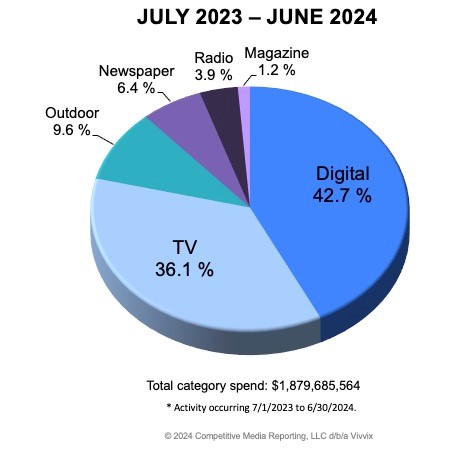
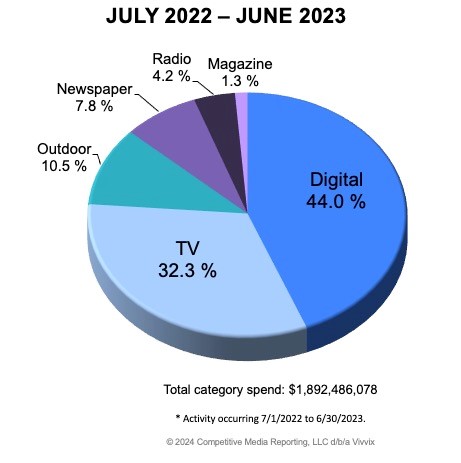
Ad spend via pie chart June 2023 - June 2024Pie chart of ad spend June 2022 - June 2023

 A Wake-Up Call

The reach and differentiation that national television buys deliver is coveted by regional banks. But the point of this post is not to highlight how big banks dominate the video creative platform with their national footprint and massive budgets. The real news is the rapid shift in television viewing habits, favoring streaming platforms, and the fact that advertisers are not adjusting their buys as quickly as consumers are changing their behaviors.

According to eMarketer in an August 2024 post:

“By 2026, U.S. adults will spend 20% of their daily media time on various apps, streaming platforms, and entertainment services on connected TVs (CTVs). That will amount to 2 hours, 34 minutes per day—up from 59 minutes in 2019. However, only 8.1% of ad budgets will be allocated to CTV by 2026.”
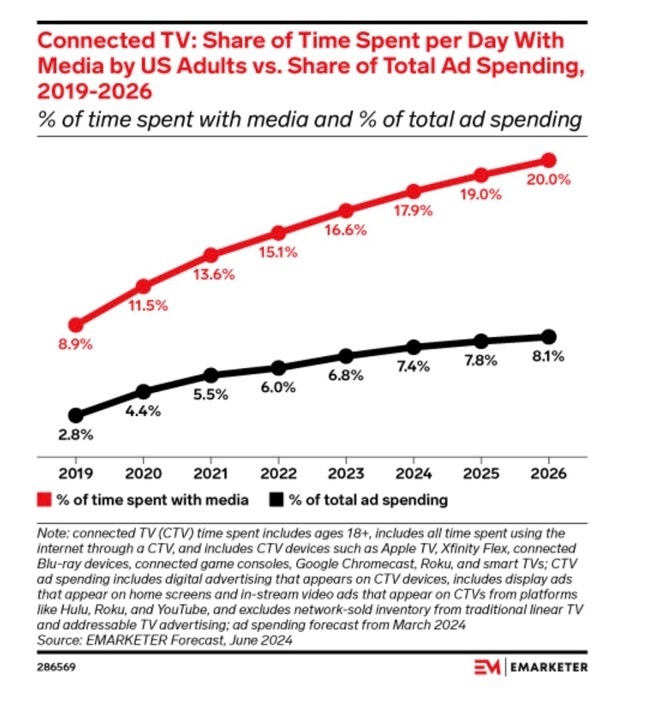
Line chart showing the share of time spent per day with media vs. the share of total ad spending

This represents a huge opportunity for smaller banks, whose brand campaigns have long been constrained. This should be a wake-up call for every regional bank. CTV and streaming TV can be purchased more cost-effectively than traditional linear TV ever could. The ability to target by zip code and demographic is ideal for banks that serve specific geographic areas, rather than entire television markets. A video brand ad on the biggest screen in the house can capture attention, evoke an emotional connection, and build trust—all crucial elements in driving consumer behavior.

Seizing the Opportunity

Regional banks are emerging from a difficult period, marked by challenges in their commercial real estate portfolios and a tough interest rate environment, all while adapting to fintech competition. They also face pressure from Big Banks and credit unions, both large and small, all vying for consumer relationships. The headwinds of the past two years have been strong enough to cause many regional banks to scale back on brand campaigns and slow down acquisition marketing.

However, the first half of this year offers some rays of hope. Yes – the macroeconomic environment looks to be improving.  But the marketing landscape also holds some very positive signs as well. First on that front: recent research indicates that Gen Z may not be as “digital only” as marketers might have assumed, despite living their entire lives with their devices.

National Survey: Baby Boomers and Gen Z least supportive of a cashless society

In a surprising twist, nearly 70% of Gen Z, despite their tech savviness, said they would not prefer a transition to a completely cashless society. This unexpectedly aligns them with almost 80% of baby boomers who share the same sentiment.

It’s critical that bank marketers begin to target Gen Z in the media channels they prefer with messages that resonate to their life stage and values. So, is it necessary to upend the media plan and add Tik Tok and YouTube Shorts?  Media usage research offers another path, led by, you guessed it Streaming Video. CTV is a media channel quickly adopted by Gen Z; usage is above average for CTV networks like Tubi, Fubo, and Pluto. But different from other media preferences (looking at you Tik Tok) CTV is a channel that has garnered quick adoption and usage across the broader generation spectrum.

Reaching a bank’s potential customers in the CTV realm should be done through specific age/demographic targeted buys. ‘Reaching the masses’ should only be done through segmented buys that allow more careful budgeting and customized product/message delivery. CTV can be the channel to reach all but a ‘one size fits all’ approach to a buy is a huge mistake to be avoided.

eMarketer’s most recent CTV user by age share shows 48% of CTV viewership comes from the 25-54 age segment.
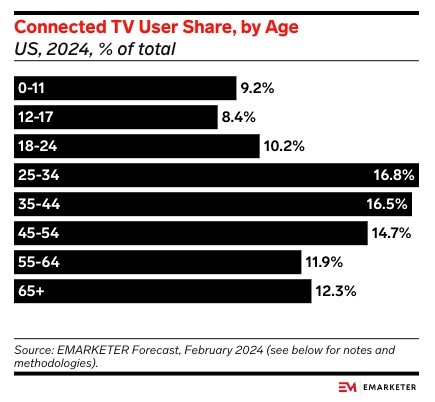
Bar chart showing the connected tv user share by age

The Path for Regional Banks

There is a path to growth for regional banks if they proactively establish their value in the marketplace through brand campaigns that tell their story. A cost-effective creative platform that reaches the masses and provides compelling communication can be built by deploying television campaigns via streaming and CTV.

Embracing the flexibility and targeted precision of CTV, regional banks have the unique opportunity to innovate their media strategies and stay ahead of the curve. By adapting to changing consumer behaviors and media consumption trends, they can effectively and efficiently build brand awareness and trust, ensuring sustained growth and relevance in a competitive marketplace.

____________________________________________________________________________________

Generation Z Is Desensitized to Digital Advertising: Here’s How Banks Can Still Win Them Over

Gen Zers on their laptops and other digital devices

Generation Z Is Desensitized to Digital Advertising: Here’s How Banks Can Still Win Them Over

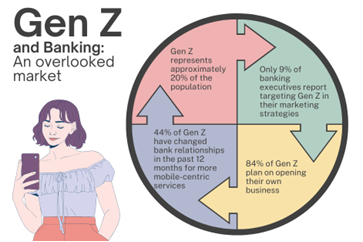
Generation Z represents about 20% of the U.S. population, meaning roughly 70 million Americans are between 12 and 27. However, in a recent survey by Capgemini, only 9% of financial service executives reported that they were actively targeting Gen Z customers with their current marketing strategies.

Is that a missed opportunity?

Considering that 84% of Gen Z plan to own their own business in the next five years, it looks to be that way. But as digital natives who grew up with smartphones and social media by their side, Gen Z has developed a remarkable ability to filter out traditional advertising. So, for banks seeking to capture their attention, a fresh approach is essential — the question is where to start.

Gen Z: What to Know

Their Mindset on Money

Gen Z is entering the financial world at a time of economic uncertainty. From navigating student debt to ongoing worries about inflation, this generation has a lot on its plate. And unlike their parents, they are more cautious about how they’re spending their money, often seeking financial literacy resources and insight on potential investment opportunities.

As the most tech-savvy generation to date, they almost all use digital finance apps like Venmo, PayPal, Vanguard, etc., which offer more spending flexibility than your standard wallet with cash and credit cards. Perhaps most importantly, they value advice on balancing saving, spending, and investing — something they generally go to sources like TikTok and YouTube for.

Their Mindset on Banks

When it comes to banks (or all brands, for that matter), Gen Z is picky about who they align with. They seek transparency, authenticity, and a company that shares their values, often digging into the details of a brand’s recent investments or acts of goodwill to determine their character.

They are less interested in the amenities of traditional banking models, such as in-office visits, personal banking concierges, etc., and are more attracted to fintech solutions that offer seamless digital experiences. In fact, a recent study indicated that 44% of Gen Z who bank with traditional financial institutions have changed their banking relationship in the last 12 months, often opting for mobile-centric services.

Their Interests

This is a generation that values creativity and self-expression. Recent studies show that around 60% of Gen Z engage in some form of artistic hobbies, such as painting, music, or writing, to cope with stress and explore their identities. They even love creative outlets like gaming, with an estimated 80% of the generation actively playing video games alone or with friends (and even their partners!).

However, they are by no means a generation of slouches — more than half of Gen Z is passionate about physical wellness, considering fitness to be a “very high priority” in their weekly routine and overall lifestyle. Brands that tap into these interests and support their creative pursuits can cultivate a strong connection with this demographic.

How to Market to Them

Consume Their Content

To understand what resonates with Gen Z, banks need to immerse themselves in the content the generation consumes. Spend time on platforms like TikTok and Instagram and pay attention to trending topics and popular influencers. Video content, particularly short-form video, is especially effective in capturing their attention.

Show What Your Brand Cares About

Gen Z wants to align themselves with brands that reflect their values. They’re well-known for being perhaps the most socially conscious generation to date. They care deeply about mental health, racial and gender equity, LGBTQ+ rights, and the environment. Moreover, they want the brands they associate themselves with to share those values.

Marketing to them is not just about what you sell but what you stand for. Highlight your bank’s commitment to social responsibility and community support. Whether through sustainability initiatives or supporting mental health awareness, make sure your efforts aren’t just visible and clear but genuine and authentic.

Guide Them

Gen Z craves financial education but doesn’t want to feel lectured. This is an important distinction, as going too far can have the opposite effect and leave them seeking information elsewhere.

Provide them with resources that align with their generational situation. Create engaging content like blog posts, webinars, and social media tips that address their specific financial challenges. Ally Invest, for example, offers an 18-page eBook to help young adults start investing, covering topics from overcoming fears to practical investment tips.

Building Trust Through Authenticity and Engagement

Data-Driven Insights

You probably know how valuable data is to the banking industry — the same applies to your advertising approach. By leveraging quantitative information about your audience, you can create a personalized marketing strategy to home in on the target demographic you’re looking to pursue.

For example, a recent study indicated that this generation has a unique attention pattern, losing their active focus on an ad in 1.3 seconds — less time than any other age group. It’s safe to say that they’ll require a different approach than what traditional advertising offers.

That means your ads need to hook the viewer immediately and maintain that attention throughout. As a result, creating engaging short-form video content (such as the videos that rule TikTok and Instagram) has begun to be the formula for winning them over.

Influencer Partnerships

Influencers play a significant role in shaping Gen Z’s opinions and purchasing decisions — so much so that entire social media trends have been based around following the actions of people with a blue check next to their username.

By partnering with influencers who align with your brand values, you can humanize your bank to an audience that otherwise considers it a very corporate, buttoned-up entity and make it more relatable. Choose influencers who might already be customers of your bank who genuinely believe in your mission and can authentically promote your services.

Omnichannel Approach

You want to avoid pigeonholing yourself to one form of media, and Gen Z expects a seamless experience across all channels.

To effectively engage Gen Z, banks should prioritize channels like TikTok, Instagram, and YouTube, as these platforms resonate most with their interests and habits. It’s also important to note that timing matters too: Research suggests that evenings, mainly between 7 p.m. and 10 p.m., are optimal for reaching Gen Z, as they are more active online during these hours, making it a great time to launch marketing campaigns.

If you want to take it a step further, consider incorporating interactive content such as polls and quizzes into your marketing tools, which can enhance engagement. Whether they interact with your brand on social media, through your mobile app, or in a physical branch, incorporating digital experiences in physical branches, such as self-service tablets and chatbots, can improve their overall experience.

Make Ads That Leave an Impression

With so many differences in lifestyle compared to generations prior, Gen Z presents a unique challenge for banks — but a unique opportunity as well. Their digital prowess and desensitization to traditional advertising force us to look at marketing differently, offering brands a chance to try marketing tactics they have never used before.

No matter what you decide, it’s important to act soon before the moment passes by. So, grab some coffee and prepare to do some research — after all, scrolling through social media ain’t all that bad.

____________________________________________________________________________________
Find Your Brands Strategy with LevLane Advertising

Not sure where to start with your bank’s marketing strategy? We’re here to help. Shoot us a message, tell your story, and we’ll be in touch.

Does Your Company Need A Brand Story? Absolutely.

  • Brand stories help the consumer to connect with your company on a deeper level
  • Brand stories aren’t about putting the company at the center, it’s about making the consumer the hero and the company the guide
  • Stories work on a deeper psychological level than fact-based marketing

Why Your Business Needs a Brand Story

Have you ever read something that connected with you? Maybe it made you laugh, think, or cry? Hit you right in the feels? About 10 years ago I read The Kite Runner by Khaled Hosseini. I still remember reading it years ago and having to put it down multiple times because it was so powerful and so moving, and I was crying so much, I couldn’t see the words on the page. Here I am, many years later and if you ask me about that book I still remember that feeling.

Now let’s think about your company. When someone asks what you do, what do you say? Do you start listing out the problems you solve? The customers you serve? Riveting.

Ask that person what you do a few days later and I’m going to bet they don’t remember, or they misremember what you told them. That’s because when the brain senses that it’s being pitched or sold to, it has a natural cognitive reaction to resist. It pushes back.

Now if we were to relay what you do in a simple, but engaging story format something very different happens. Your brain actually takes that information and claims it as it’s own- as if they found it. That’s because your mind spends 30% of it’s waking time daydreaming– when you work, drive, etc. But when you are watching a movie, reading a great book, or listening to a great story, your brain doesn’t daydream: That story is doing the daydreaming for you. The story has literally taken over the brain.

Stories go beyond a product. They resonate because they’re human. They hit you in the feels.

It’s not a list of features. It’s not telling them how great your company is, all the great things you’ve done, or all the people who love you. It’s about the customer, your hero. Your company is merely the guide or the helper to get the hero to the finish line.

And you don’t have to take my word for it. A recent study shows that when you read stories that evoke emotion, it stimulates the brain and even changes how you act.

What’s a Brand Story?

A company’s brand story isn’t about throwing together a quick persona and then using it in your PowerPoints and explainer videos. It has a narrative that carries through your site, sales pitch, marketing campaigns, brand voice, logo, and branding. It’s using the best elements of writing to develop a storyline that creates a personality customers can connect with.

[Cue the obligatory Apple-Steve Jobs anecdote.]

When Apple re-emerged with the iPod Classic, it was a story. And it wasn’t a story that revolved around Apple or Steve Jobs. It was about the user and their connection to the music and how they made it easier for people to store, access and listen to the music they loved. And while Apple was part of the story, it was a guide, an assistant to get the hero – YOU – closer to your music. Apple has one of the most loyal, – almost to the point of illogical – fan bases. They are part of the fabric of the user’s everyday life. They are not just well-liked, they are BELOVED.

How Do You Create a Brand Story?

Your story should be built around your hero, and that hero isn’t your company. The hero is your customer. And just like in any good story the hero is a well-developed character who experiences a conflict that’s resolved with the help of a guide.

Creating a brand story is an art and a craft. It takes a lot of work, research, and editing. It makes knowing your target audience at a level that goes beyond just the demographics- it goes to psychographics. What does your ideal customer worry about? What are they struggling with? How does that struggle make them feel? Using the best practices from thousands of years of storytelling and creative writing ensures that you have a story that injects personality into your brand- and your personality and story are what your customer connects with.

The Intern Experience

Colin Dame: Advertising Major, Temple University, Class of 2019

Here at LevLane, helping students prepare for the corporate world through our intern program is something that, as a company, we pride ourselves on. We take their contributions seriously and we welcome the many innovative and fresh ideas they bring to the table. In fact, many of our best and hardest working team members began their careers with us as interns.

Colin Dame has had a similar journey and recently wrote an essay describing what his intern experience has been like with LevLane thus far. So, in his own words, and with his usual quirky spin on things, here is Colin’s intern experience…with a twist.

What Rihanna Taught Me About the Advertising Industry

By: Colin Dame

While earning my bachelor’s degree in Advertising at Temple University I participated in LevLane’s Intern program. For the past two semesters, I have been splitting my time between studying for my degree and learning everything I can about the inner workings of an ad agency.

As you may know, advertising agencies are high-pressure incubators for marketing and creative professionals. What you might not know is that Rihanna totally interned at an ad agency before she started singing. In fact, one of her most popular songs gives deep insight into what it’s like at an agency…well, kind of. I’ve broken down some of those lyrics into lessons any aspiring intern can use in the day-to-day.

The Lyric: You see me I be work, work, work, work, work, work

The Lesson: Ask For More Work

Rihanna gets it! Agency life is about putting in the work, work, work, work, work, work. But even in the slow moments, you need to get the most out of your time as an intern. Tasks run dry? Ask the media department if they need help with some reporting. Recently, I stepped in to help our SEO director with some keyword research, a vital skill for any aspiring content marketer, web developer or social media strategist; not to mention an easy resume builder!

The Lyric: You see me do me dirt, dirt, dirt, dirt, dirt, dirt

The Lesson: Ask For Help

What you do isn’t dirt! Everything you do is to help your client’s business. But you’re not a seasoned adperson…yet – there’s no reason you should know everything. There have been times when a manager has given me an assignment, and 10 minutes into it, I had no idea what was going on. It’s crucial to ask for clarification. Your supervisors completely understand that agency-talk can be a foreign language to you.

The Lyric: There’s something ’bout that work, work, work, work, work, work

The Lesson: Get Involved Wherever You Can

Agency life includes a lot of different interactions with clients – they are the folks paying you after all! Sitting in on meetings is a great way to better understand business communications in an agency. In meetings, you will learn when to talk, to whom to talk, how to talk, and what to say. Incorporating those fundamentals will take you far in this client-centric world.

The Lyric: When you a gon’ learn, learn, learn, learn, learn, learn

The Lesson: Go Outside Your Department

If you’re lucky enough to work at a full-service agency, you’ll quickly realize that the people there all do very different things. Introduce yourself to someone new every day. Chat with an art director about what their process looks like. Introduce yourself to someone you haven’t met before. If people in the office know your name and know what work you’ve contributed to, you lay the groundwork to making great network connections or a chance to join the agency full-time.

The Lyric: Me na care if me tired, tired, tired, tired, tired, tired

The Lesson: Self-Care is Key

You’re driven. That’s why you’re an intern, right? You want the best possible job out of college because you want to produce the best work. Well, you can’t do that if you’re running on empty with a flat tire. Nix going out 5 nights a week, and go get some sleep! Your future self and career will thank you.

Attach the Attachment

Ok, not a lyric, but it’s so important to be present during this experience. Take each moment one step at a time, and don’t think 6 steps ahead. If you’re sending your supervisor a deliverable, she’s never going to know how beautifully thought out it is if you forget to actually attach the attachment. Proof and edit each assignment with superb detail, and your supervisors will love you for what little work they will need to do to anything you turn in. Trust me, the easier you make their job the happier they’ll be!

Yes, being an intern is a requirement for graduating but if you do it right it can most certainly work to your advantage. A few reminders: do your research, find an internship that is the right fit for you and immerse yourself in any way you can within the company and you will get the most out of your intern program! Hopefully, these tips help you in your journey to become the next top CCO, CMO (or agency intern turned superstar if you decide to follow in Rihanna’s footsteps instead).

The Hub of the LevLane Wheel: Donna Pangione, Director of Production

Donna Pangione, Director of Production

Donna Pangione, Director of Production

Since she joined LevLane in 2010, Donna Pangione has often been referred to as the “hub” that keeps the agency’s projects in motion, from concept to completion. Here’s why:


How does your position fit into the functions of the rest of the agency?

Our department brings the project to life. Whether that’s a brochure, an outdoor billboard, print advertising, t-shirts – we handle it from start to finish and deliver the final product.


What led you to LevLane?

I had worked at LevLane years ago, and remembered the friendly people. I was glad to find that a lot of the people were actually still here!  In this ever-changing world of advertising, it is rare to find so many familiar faces so many years later.


How did you know this was the right position/career path for you?

I loved the subjects of art and English growing up. Penn State University had an advertising major at the time, so I thought that would be a good mix of both!  Now, I am one of the few Penn State Alumni with an actual advertising degree.


What is a typical day at LevLane like for Donna Pangione?

I manage the creative workflow, answer A LOT of questions, answer a lot of phone calls, double-check, double-check, double-check, review proofs, and most importantly ensure that everything is produced on time and within budget.


What is the most challenging aspect of your role at LevLane?

I interact with everyone on a daily basis and each department has its own idiosyncrasies. It can be challenging handling multiple personality types in the appropriate manner. It is also difficult to partake in the multiple steps involved in the successful completion of a project. My anticipation is always to exceed clients’ expectations, so there is a lot of back and forth and verifying to ensure that all parties are satisfied and that the final product looks as close to perfect as possible.


What is the most rewarding aspect of your role?

It is so satisfying to see the finished product and working collaboratively with others to develop the best possible creation.  And I love when I come in under budget!


What types of projects do you most enjoy, and why?

I love utilizing unique printing techniques that just add the final, special touches to a design. Embossing, UV coating, varnishing techniques, foil-stamping, die cuts…it’s fun!


What’s your favorite thing about LevLane?

Everyone works really hard and at the same time the atmosphere is laid back, fun, and friendly.  I also thrive on the fast pace of the agency. The ever-changing environment allows the day to go by quickly and there is always something to do.


How do you handle the constant pressure of working on multiple deadlines?

Jogging!! Also, remembering that we are all working toward the same goal and that the deadlines always end in a beautifully-executed design.


As the head of your team, what plans or goals do you have for Production over the next year?

I’m really excited for the new software that we recently began using. It is a system that enhances project management tools. The goal is to further explore how it can facilitate our workload and make managing and interpreting creative needs more feasible and efficient.


Do you have any advice for someone trying to enter/advance in your area?

Follow your heart!! You’ll be successful…whatever success means for you. But above all, only you know how to make yourself happy. Follow your heart and you’ll get there.


What are some personal qualities that help you do your job efficiently?

My ability to “see the forest for the trees” has brought me a long way in this industry – sometimes it just takes common sense. My job requires careful consideration to budgets and timing, which are essential when it comes to producing projects as directed. I also try my best to be a good listener – that’s very important! Whether it’s filing each project into a “job jacket” or organizing the various folders on my desktop, my ability to organize has been a great help. It is extremely important to pay attention to detail and stay one step ahead of the game.


Some people describe you as “the glue” here at LevLane. Why do you think that is?

My department is kind of like the quarterback of a football team.  Our job is to throw the ball and to set the play in motion for the rest of the agency. Without direction, it is hard to know where to begin and how to proceed. The glue is unseen, right?!  Another way to put it is that we are like the hub of a wheel – everything starts and ends here and turns all around the central location. We are able to take note of the details and note any inconsistencies to bring the project up to par.


If you could go anywhere in the world, where would it be? Why?

To Key West to paint sweatshirts on Sunset Pier….yup, that’s where I’d like to be right now. (She showed me pictures. It’s awesome!)

***

By Gena Bushnell, LevLane Spring 2015 PR Intern and marketing major at Saint Joseph’s University


LevLaners Show Love to Adoptions From The Heart

Each November, the walls and doorways of LevLane’s offices start to fill up with purple paper hearts – each one representing a dollar donation made to Adoptions From the Heart during National Adoption Month by a LevLane employee. Eventually, they form a sea of purple, and represent a sizable annual donation to AFTH from the LevLane staffers who donate. This annual tradition was started and is continued each year by VP, Digital Media Director Dan Hall, who’s been with LevLane for 13 years.

1. How and when did you first become aware of or get involved with Adoptions From the Heart?

We became involved through our son Matthew. We adopted Matthew through Adoptions From The Heart in 2010. When we decided to adopt, we looked at a few difference adoption agencies. Adoptions From the Heart seemed the most welcoming…the most open. Unlike some of the other agencies we met with Adoptions From The Heart didn’t care about your religion or your sexual preference. They just want you to provide a happy, healthy homes for children…to be a family. They also stressed the importance of openness between the adoptive parents and the birthmother, which can be scary for new adoptive parents. But we quickly learned how important openness and the adoption story is to the child. We selected Adoptions From the Heart and had a flawless experience. We were very fortunate. Now we have a family.

2. What made you want to support AFTH?

After we adopted Matthew, Adoptions From the Heart sent out a request for volunteer board members. My wife suggested I apply. They helped give me the greatest gift I will ever have in my life, so volunteering was the least I could do.  I applied. They accepted. I help in anyway I can.

3. What do the employee donations for Adoptions From The Heart go towards? 

Donations go to the Adoptions From the Heart Birthmother Fund.  The fund helps women who have had an unplanned pregnancy and are trying to make a tough choice during a difficult time in their life. Adoptions From the Heart provides free advice, counseling and financial support for these women in need.

4. Is it true that the total amount of donations made by LevLane employees each year is among the largest that AFTH receives?

They have many organizations that graciously contribute.  I am proud to say that LevLane is among the top contributors for this fund drive.

5. How does it feel to be the steward for what has become such a large, annual collection effort?

I have personally benefited greatly from the work Adoptions From the Heart does, but most folks in the office have never or will never need or use their services. Yet, they come into my office in droves with their hard-earned cash in hand willing to help out. It always warms my cold, black heart.

Here’s how to get the most from your agency internship

Gina Turdo, Public Relations Major, Rowan University Class of 2015

Gina Turdo, Public Relations Major, Rowan University Class of 2015

Two-term LevLane intern offers five top tips

Six months ago, I walked into LevLane as a public relations intern with little office experience, and not a clue of what to expect. For two semesters, I sat at the front desk in LevLane’s lobby greeting clients, helping them to their meetings, and feeling my heart sink when I could not match a face to the name of the colleague that the client was in to see. The frantic feeling quickly faded and my confidence grew as I began to work and interact more with my new co-workers.

My internship at LevLane has taught me about the industry I’m pursuing, what to expect from PR life inside an advertising agency, and most importantly, what is expected from me. My activities ranged from checking in dozens of media members at a big event, to contributing to blog posts and press releases, to sitting in on client calls and brainstorming meetings.

As terrifying as my first few months may have been, I now see what a gratifying opportunity it has been to watch such a successful integrated agency operate. In my final days at LevLane, I have been asked to share my top five intern tips, so that they might benefit other interns to follow:

Smile

As an intern you’re not supposed to know what to expect, and with that will always come nerves and uncertainty. No matter how unsure you are of yourself or your surroundings, a confident smile will always be the best way to smooth over any uncertainties that you may be experiencing.

Be prepared

From having multiple copies of your resume available when you arrive for your interview (trust me, you never how many people you will end up interviewing with), to always having pen and paper handy in case of being called into a meeting, being ready means you have it together. A trustworthy intern is never scrambling or unorganized, and although none of us start out like this, it should be your goal to leave this way.

Prove yourself

You have landed an internship, and you are right where you want to be – now it’s time to work. Intern work may seem mundane and unimportant, but in the grand scheme of things, intern tasks are often foundational layers for the work that comes next. Completing these tasks in an efficient and timely manner will not only prove your worth, it will improve the work and outcome for the agency. These experiences will also serve as great practice for you as a PR professional. Landing an internship alone does not prepare you for what may lie ahead, but presents you with an opportunity to immerse yourself in every task and to learn as much as possible.

Open up

Feeling like the lowest man on the totem pole will never be fun, but it’s easier if you open up to the people around you. There is nothing wrong with asking for help if you don’t understand something, and there is great reward in having the courage to respectfully add your input once you’re comfortable. Getting involved and reaching out to others is the absolute best way to break out of your comfort zone and form professional relationships – and even new friendships – along the way.

Learn and grow

Your internship will give you the opportunity to dive head first into an industry that you love, and will serve as a way for you to gain valuable experience you can’t get in a classroom. How much you absorb while you’re immersed in this world is completely up to you. Within this learning period, you have a unique opportunity to learn about yourself; take advantage of it. The experience will allow you to figure out what you like and what you don’t, who you are as a worker among others, and the truth about your shortcomings juxtaposed directly against your strengths. An internship does not just fulfill a credit requirement, or hold a place on your resume; an internship rubs your rough edges smooth, instills a new air of confidence, and helps you evolve into a professional who’s ready for anything.

By Gina Turdo, Public Relations Major, Rowan University Class of 2015