The $3.5 Million Retirement Goal: Are We Ready?

By 2065, it’s estimated that American’s will need $3.5 million in order to retire.

What if I told you that by 2065, the average American will need $3.5 million to retire?  

It’s a number that feels almost absurd—like something plucked from a dystopian novel rather than a real financial projection. And yet, this is the reality we’re staring down––one that’s forcing us to confront some uncomfortable truths about the future of aging, financial security, and what the word “retirement” means for generations who haven’t even bought their first house yet. 

But more importantly, it raises a critical question: Are we ready? 

Based on data from our recent survey done with our partners at Talker Research, we’ll explore the forces driving this $3.5 million projection––from the emotional and practical implications for those who will be affected to the urgent need for industries to adapt to a future that’s closer than we think.  

Solving this problem isn’t just a financial challenge––one that requires people to save more money or work longer hours––it’s about changing our culture to meet the needs of the next generation where they are.  

But before we start talking about a change in culture, let’s start at the beginning. 

Why $3.5 Million? 

The $3.5 million figure isn’t arbitrary; it’s a reflection of the economic and societal shifts that are already underway. Rising healthcare costs, continued inflation, and longer life expectancies are all contributing to a significant increase from the 1-million-dollar retirement fund estimation that lives as the current status quo. 

To put it in perspective: By 2065, the average household income is expected to reach $508,950—a staggering 536% leap from today’s $80,610. And with costs rising across the board in all directions, the financial demands of retirement will only grow more intense. 

But it’s not just about the numbers. Generational perspectives on retirement are shifting dramatically as well. According to our research, 57% of Gen Z believe retirement won’t even be an option for most people in 40 years.  

The skepticism is fairer than you may think. It stems from a combination of economic uncertainty and a redefinition of what it means to age. For many younger Americans, the traditional idea of retirement—leisurely days in luxury communities, traveling the world—is being replaced by visions of multigenerational living, off-grid retreats, and purpose-driven lifestyles. 

The emotional weight of this figure is undeniable. It’s not just a financial hurdle—it’s a source of anxiety for individuals and families trying to plan for an uncertain future. And it’s a challenge for industries that must adapt to meet these evolving needs. 

Rethinking Retirement: It’s Not Just About the Money 

The $3.5 million goal forces us to ask a deeper question: What does retirement even mean in 2065? For many, it’s no longer about financial freedom alone—it’s about connection, flexibility, and purpose. 

Younger generations are already redefining what their golden years will look like. According to the research, 29% of Gen Z want to live with family to watch future generations grow, while 20% dream of traveling the world and even space. Others envision owning hobby farms (17%), living off the grid (16%), or creating co-living communities with friends (15%). These aspirations reflect a shift in values away from material excess and toward meaningful experiences. 

The shift here is a significant one. Rather than looking at retirement as a defined endpoint, Gen Z views retirement as a more flexible state of financial independence created through continuous work. More importantly, work that doesn’t infringe upon their desires for work-life balance—a priority for more than 70% of Gen Z members, per a recent survey by Randstad. 

Safe to say, many members of the generation don’t see a traditional retirement as a possibility. Instead, they’d rather focus on developing a flexible career path that can help them follow their passions and “live their best life”—a divergence from the standard work structure that many of us have come to know.  

The Industry Perspective: Are We Ready to Adapt? 

The $3.5 million retirement goal isn’t just a challenge for individuals—it’s a wake-up call for industries that serve them. Financial institutions, real estate developers, and policymakers will need to rethink their strategies to address the needs of future retirees. 

For financial institutions, this means moving beyond traditional savings plans. What other services or innovative solutions can be created to help account for longer lifespans and higher costs? Are banks and advisors prepared to guide clients toward this ambitious goal? Are they leveraging technology like AI to provide personalized, adaptive financial planning? More than ever, it’s imperative that banks start working with customers at a younger age to help people prepare for the significant rise in costs set to come in the not-so-distant future. 

The real estate sector will also need to adapt. With 25% of Americans anticipating renting for life, the demand for affordable, flexible housing options will only grow. Co-living communities, multigenerational homes, and sustainable housing solutions could become the norm, but only if the industry is willing to innovate…is it? 

Policymakers, too, have a role to play. Addressing systemic issues like the retirement savings gap, affordable healthcare, and housing accessibility will require bold action and forward-thinking policies. With the rise of AI, will financial literacy become more accessible and standardized? Or do we find ourselves in a situation where the masses are left behind? 

With so much to consider, it’s impossible to know where to start, but we know we need to start now. 

Preparing for the Future: What Comes Next? 

So, what can we do to prepare for a future where $3.5 million is the new retirement benchmark? 

For Individuals: Start planning now. Saving earlier, diversifying investments, and embracing new financial tools can make a significant difference. It’s also important to rethink what retirement means to you—whether it’s about financial freedom, personal growth, or something else entirely, it’s more important than ever to have some vision in mind for your senior years. 

For Industries: Financial institutions and real estate developers will need to innovate their current models now to effectively meet the needs of future retirees. This could mean offering new paths to saving, creating affordable housing solutions, or leveraging technology to provide better services earlier on, when compound interest can still help the younger generations make headway on their $3.5 million target number. 

For Society: A collective shift in how we think about aging and retirement is already in the works. Now it’s just about advancing those values so they work for the up-and-coming working class. Advocating for policies that address systemic challenges and creating a culture that values flexibility, freedom, and purpose over material excess will be key, helping people prioritize happiness over the picket fence storybook ending we’ve grown accustomed to. 

The $3.5 million retirement goal isn’t just a number—it’s a challenge to rethink what retirement means and how we prepare for it. It’s a call to action for individuals, industries, and society as a whole to adapt to a future that’s already taking shape. 

For younger generations, it simply may not be enough to work harder in the system that’s already been built for them—it may require that system to be reconstructed in a way that better serves those who will reap the benefits from it down the line. 


Young Women Are Getting Richer, and Banks Need to Pay Attention

A successful, working Gen Z woman

Empowering a New Era: How Banks Must Adapt to the Rising Economic Power of Young Women

The financial landscape is undergoing a seismic shift, with young women at the heart of this transformation. Financial institutions, especially regional and community banks, are facing the new reality that is the burgeoning economic power of Generation Z and millennial women. For smaller regional and community-focused banks, adapting their approach will be critical in this new era where young women are poised to control significant wealth.

Gen Z and Millennial Women: Who Are They?

Understanding Their Demographics

Who exactly are these young women reshaping the financial world? Gen Z women are typically born between 1997 and 2012, while millennials were born between 1981 and 1996. Together, these groups represent a significant portion of the workforce and are rapidly becoming an economic force to be reckoned with. Many are college educated, tech savvy, career focused, and value driven, seeking not only financial stability but also meaning and impact in their investments.

Income and Lifestyle

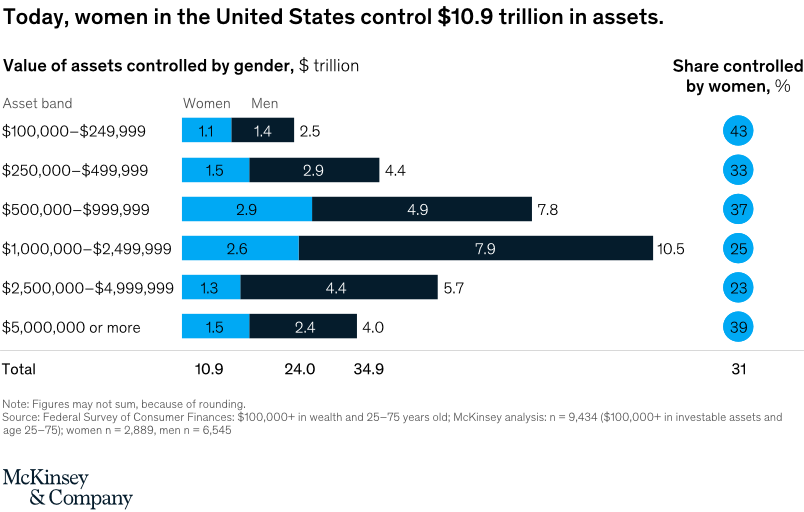
Gen Z and millennial women have made their impact in corporate America and are increasingly occupying leadership roles in various industries, which translates to higher incomes than in decades and generations past. According to a McKinsey report, women are projected to control $30 trillion in financial assets by the end of the decade. Despite this growing wealth, many of them feel that traditional banking services don’t resonate with their unique needs and aspirations.

Financial Situations and Goals

Unlike their counterparts of previous generations, these young women face unique financial challenges, including student debt and housing affordability. In addition, a growing percentage of them are staying single, with the share of never-married women growing by 20% in the past decade. As a group, they are focused on saving for the future, investing wisely, and making informed financial decisions, but their financial goals often extend beyond mere wealth accumulation to include social responsibility and sustainable investing.

The Great Wealth Transfer and the Feminization of Wealth

What Is the Great Wealth Transfer?

Over the next 20 years, an estimated $80 trillion will change hands as older generations pass on their wealth. As a significant portion of this wealth transfer benefits Gen Z and millennial women and positions them as key financial decision-makers, banks and financial institutions should be ready with a plan to speak to and cultivate this newly wealthy audience.

The Implications for Banks

This monumental shift, often referred to as the “Great Wealth Transfer,” signifies a crucial opportunity for banks to rethink their strategies. According to a Capgemini survey, only 9% of financial services executives are targeting Gen Z customers. Ignoring this demographic could result in missed opportunities and a failure to capture a loyal customer base.

What Can Banks Do to Better Serve This Demographic?

The Power of Influence(rs)

The good news for banks is that young women are already interested in financial news. A growing number of them are following influencers and online communities focused on financial topics. Platforms like Instagram and TikTok are rife with financial advice tailored to their needs — but just because it’s there and popular doesn’t make it good advice. Banks have a built-in credibility that they can and should leverage on these platforms to engage with young women and build trust through authentic, relatable content. The key to connecting with that audience is to not use the same approach that they’ve been using in the past — it has to feel appropriate for the channel first. Anything that comes across too stiff or formal will feel inauthentic and unrelatable, so banks will need to get comfortable with a new approach to content if they want to connect.

An Adjustment in Offered Services

One of the biggest frustrations for Gen Z and millennial women is the lack of tailored financial services. Many banks offer generalized services that don’t address their specific needs, such as managing student debt, financial planning for singles, investing sustainably, or planning for future family life. By offering customized solutions in formats that resonate, banks have the opportunity to foster long-term loyalty with a base that is historically loyal to organizations that they feel a connection with.

Understand Their Needs

Young women often feel misunderstood or unseen by traditional financial institutions. They seek banks that can empathize with their struggles and offer solutions that level the playing field. By conducting user research into their needs, wants, and preferences and by leveraging transaction data, banks can gain deeper insights into the financial behaviors and preferences of young women and can better tailor their products, services, and resources.

Avoid Patronizing at All Costs

Historically, women have felt sidelined and patronized by the financial services industry. For decades, men have been the primary targets of the thinking, messaging, and advertising for most financial institutions and organizations. But with the coming feminization of wealth, it’s time for banks to rethink that approach. How can they do that effectively? By providing non-patronizing, accessible financial planning tools that empower young women to make informed decisions. This means educational resources, user-friendly digital interfaces, and personalized advice that respects their intelligence and ambition as well as their relationship status and how that affects their plans.

A Chance to Build Long-Term Loyalty with a New Base

The economic landscape is evolving, and young women are emerging as powerful financial players. For banks, this presents both a challenge and an opportunity. By understanding the unique needs of Gen Z and millennial women and offering tailored services, banks can not only capture this valuable market but also build lasting relationships based on trust and mutual growth.

It’s time for banks to recognize the rising economic influence of young women and adapt their strategies accordingly. Those that do will not only thrive in the current financial ecosystem but will also pave the way for a more inclusive and innovative banking future.

____________________________________________________________________________________

Find Your Brands Strategy with LevLane Advertising

Not sure where to start with your bank’s marketing strategy? We’re here to help. Shoot us a message, tell your story, and we’ll be in touch.

Outsmart the Giants: How Regional Banks Can Beat the Big Banks at Their Own Game with CTV Advertising

A couple on the couch watching a streaming platform

What’s in Your Media Plan?

If you’re one of the top financial brands, the answer to that question likely includes an eight-figure television ad spend. Television has been the cornerstone of big banks’ media campaigns for decades. But why is that? Our media landscape has drastically evolved; the decline of television has been predicted for years, with Nielsen data backing that claim. Yet, despite the headlines, TV still dominates big banks’ media mix. What could explain this? Is it corporate inertia — spend it or lose it? Is it a media plan stuck in 2015? Or is it a carefully crafted communication strategy rooted in research and results?

Given the budgets and the stakes involved, it’s likely the latter. These banks understand and value the brand awareness and recall that video provides, especially in an industry like banking, where establishing a top-of-mind presence is critical.

A Clear Winner

National banks have consistently relied on television as a key component of their advertising media mix. A compelling case for this investment is made in a recent report by Peter Field and the IPA, titled, Why TV is Still at the Heart of Effectiveness. Field argues that to drive maximum growth brands must deploy both long-term effectiveness strategies and bottom-of-the-funnel performance marketing. As the report states, TV remains the clear winner in delivering long-term effectiveness. Field’s case is well-documented, with research highlighting three key factors: Attention, Emotional Clout, and Trust. For the financial sector, the link Field draws between trust and profitability is particularly compelling and essential to consider when crafting media plans.

The Field report, along with other industry research, makes a strong case for TV. It’s safe to assume that big national banks have primary brand research that justifies their television investments. However, it’s also plausible that these large organizations, given their size, are slow to adapt to the changing television landscape — a fact evident in their advertising media mix.

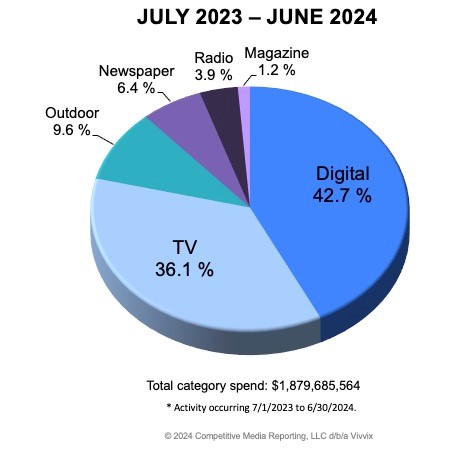
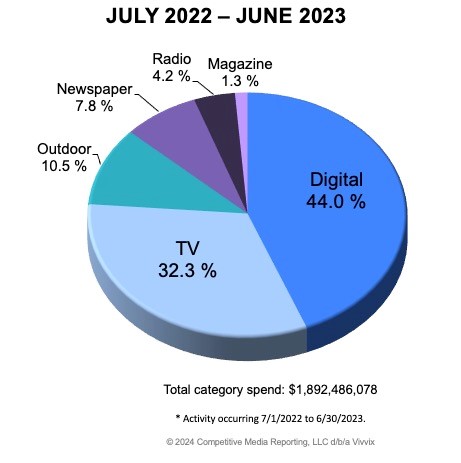
In the most recent 12-month period (July 2023-June 2024), the top 100 banks allocated 36% of their total media spend to traditional television. While total spend remained flat compared to the previous year, the share of traditional television increased by 4 percentage points, equating to an 11% rise in spend.

Ad spend via pie chart June 2023 - June 2024Pie chart of ad spend June 2022 - June 2023

 A Wake-Up Call

The reach and differentiation that national television buys deliver is coveted by regional banks. But the point of this post is not to highlight how big banks dominate the video creative platform with their national footprint and massive budgets. The real news is the rapid shift in television viewing habits, favoring streaming platforms, and the fact that advertisers are not adjusting their buys as quickly as consumers are changing their behaviors.

According to eMarketer in an August 2024 post:

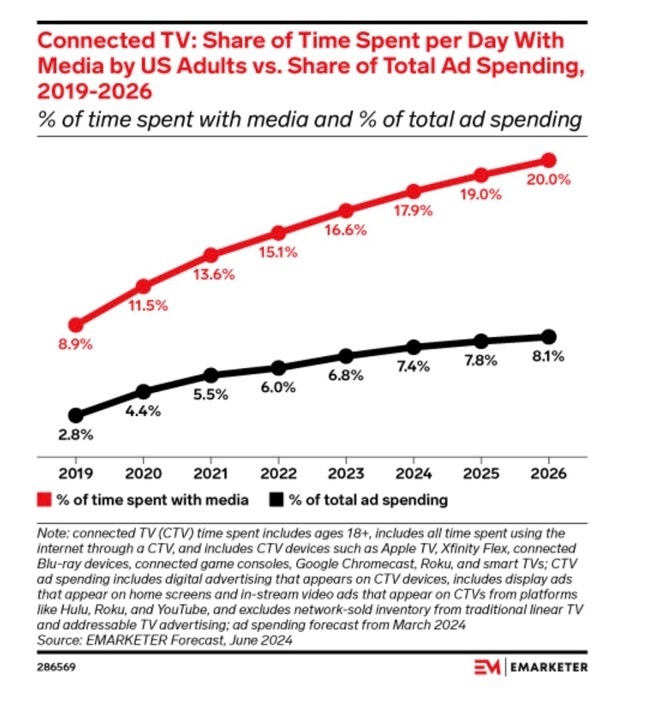
“By 2026, U.S. adults will spend 20% of their daily media time on various apps, streaming platforms, and entertainment services on connected TVs (CTVs). That will amount to 2 hours, 34 minutes per day—up from 59 minutes in 2019. However, only 8.1% of ad budgets will be allocated to CTV by 2026.”

Line chart showing the share of time spent per day with media vs. the share of total ad spending

This represents a huge opportunity for smaller banks, whose brand campaigns have long been constrained. This should be a wake-up call for every regional bank. CTV and streaming TV can be purchased more cost-effectively than traditional linear TV ever could. The ability to target by zip code and demographic is ideal for banks that serve specific geographic areas, rather than entire television markets. A video brand ad on the biggest screen in the house can capture attention, evoke an emotional connection, and build trust—all crucial elements in driving consumer behavior.

Seizing the Opportunity

Regional banks are emerging from a difficult period, marked by challenges in their commercial real estate portfolios and a tough interest rate environment, all while adapting to fintech competition. They also face pressure from Big Banks and credit unions, both large and small, all vying for consumer relationships. The headwinds of the past two years have been strong enough to cause many regional banks to scale back on brand campaigns and slow down acquisition marketing.

However, the first half of this year offers some rays of hope. Yes – the macroeconomic environment looks to be improving.  But the marketing landscape also holds some very positive signs as well. First on that front: recent research indicates that Gen Z may not be as “digital only” as marketers might have assumed, despite living their entire lives with their devices.

National Survey: Baby Boomers and Gen Z least supportive of a cashless society

In a surprising twist, nearly 70% of Gen Z, despite their tech savviness, said they would not prefer a transition to a completely cashless society. This unexpectedly aligns them with almost 80% of baby boomers who share the same sentiment.

It’s critical that bank marketers begin to target Gen Z in the media channels they prefer with messages that resonate to their life stage and values. So, is it necessary to upend the media plan and add Tik Tok and YouTube Shorts?  Media usage research offers another path, led by, you guessed it Streaming Video. CTV is a media channel quickly adopted by Gen Z; usage is above average for CTV networks like Tubi, Fubo, and Pluto. But different from other media preferences (looking at you Tik Tok) CTV is a channel that has garnered quick adoption and usage across the broader generation spectrum.

Reaching a bank’s potential customers in the CTV realm should be done through specific age/demographic targeted buys. ‘Reaching the masses’ should only be done through segmented buys that allow more careful budgeting and customized product/message delivery. CTV can be the channel to reach all but a ‘one size fits all’ approach to a buy is a huge mistake to be avoided.

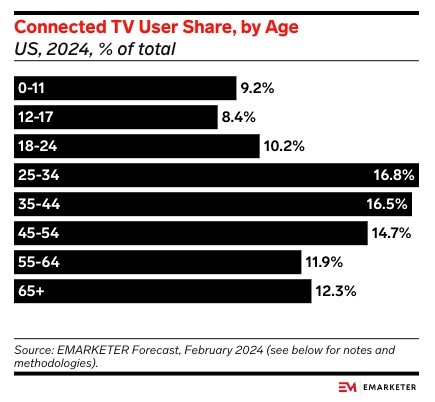
eMarketer’s most recent CTV user by age share shows 48% of CTV viewership comes from the 25-54 age segment.

Bar chart showing the connected tv user share by age

The Path for Regional Banks

There is a path to growth for regional banks if they proactively establish their value in the marketplace through brand campaigns that tell their story. A cost-effective creative platform that reaches the masses and provides compelling communication can be built by deploying television campaigns via streaming and CTV.

Embracing the flexibility and targeted precision of CTV, regional banks have the unique opportunity to innovate their media strategies and stay ahead of the curve. By adapting to changing consumer behaviors and media consumption trends, they can effectively and efficiently build brand awareness and trust, ensuring sustained growth and relevance in a competitive marketplace.

____________________________________________________________________________________

Generation Z Is Desensitized to Digital Advertising: Here’s How Banks Can Still Win Them Over

Gen Zers on their laptops and other digital devices

Generation Z Is Desensitized to Digital Advertising: Here’s How Banks Can Still Win Them Over

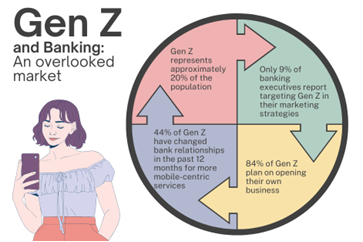
Generation Z represents about 20% of the U.S. population, meaning roughly 70 million Americans are between 12 and 27. However, in a recent survey by Capgemini, only 9% of financial service executives reported that they were actively targeting Gen Z customers with their current marketing strategies.

Is that a missed opportunity?

Considering that 84% of Gen Z plan to own their own business in the next five years, it looks to be that way. But as digital natives who grew up with smartphones and social media by their side, Gen Z has developed a remarkable ability to filter out traditional advertising. So, for banks seeking to capture their attention, a fresh approach is essential — the question is where to start.

Gen Z: What to Know

Their Mindset on Money

Gen Z is entering the financial world at a time of economic uncertainty. From navigating student debt to ongoing worries about inflation, this generation has a lot on its plate. And unlike their parents, they are more cautious about how they’re spending their money, often seeking financial literacy resources and insight on potential investment opportunities.

As the most tech-savvy generation to date, they almost all use digital finance apps like Venmo, PayPal, Vanguard, etc., which offer more spending flexibility than your standard wallet with cash and credit cards. Perhaps most importantly, they value advice on balancing saving, spending, and investing — something they generally go to sources like TikTok and YouTube for.

Their Mindset on Banks

When it comes to banks (or all brands, for that matter), Gen Z is picky about who they align with. They seek transparency, authenticity, and a company that shares their values, often digging into the details of a brand’s recent investments or acts of goodwill to determine their character.

They are less interested in the amenities of traditional banking models, such as in-office visits, personal banking concierges, etc., and are more attracted to fintech solutions that offer seamless digital experiences. In fact, a recent study indicated that 44% of Gen Z who bank with traditional financial institutions have changed their banking relationship in the last 12 months, often opting for mobile-centric services.

Their Interests

This is a generation that values creativity and self-expression. Recent studies show that around 60% of Gen Z engage in some form of artistic hobbies, such as painting, music, or writing, to cope with stress and explore their identities. They even love creative outlets like gaming, with an estimated 80% of the generation actively playing video games alone or with friends (and even their partners!).

However, they are by no means a generation of slouches — more than half of Gen Z is passionate about physical wellness, considering fitness to be a “very high priority” in their weekly routine and overall lifestyle. Brands that tap into these interests and support their creative pursuits can cultivate a strong connection with this demographic.

How to Market to Them

Consume Their Content

To understand what resonates with Gen Z, banks need to immerse themselves in the content the generation consumes. Spend time on platforms like TikTok and Instagram and pay attention to trending topics and popular influencers. Video content, particularly short-form video, is especially effective in capturing their attention.

Show What Your Brand Cares About

Gen Z wants to align themselves with brands that reflect their values. They’re well-known for being perhaps the most socially conscious generation to date. They care deeply about mental health, racial and gender equity, LGBTQ+ rights, and the environment. Moreover, they want the brands they associate themselves with to share those values.

Marketing to them is not just about what you sell but what you stand for. Highlight your bank’s commitment to social responsibility and community support. Whether through sustainability initiatives or supporting mental health awareness, make sure your efforts aren’t just visible and clear but genuine and authentic.

Guide Them

Gen Z craves financial education but doesn’t want to feel lectured. This is an important distinction, as going too far can have the opposite effect and leave them seeking information elsewhere.

Provide them with resources that align with their generational situation. Create engaging content like blog posts, webinars, and social media tips that address their specific financial challenges. Ally Invest, for example, offers an 18-page eBook to help young adults start investing, covering topics from overcoming fears to practical investment tips.

Building Trust Through Authenticity and Engagement

Data-Driven Insights

You probably know how valuable data is to the banking industry — the same applies to your advertising approach. By leveraging quantitative information about your audience, you can create a personalized marketing strategy to home in on the target demographic you’re looking to pursue.

For example, a recent study indicated that this generation has a unique attention pattern, losing their active focus on an ad in 1.3 seconds — less time than any other age group. It’s safe to say that they’ll require a different approach than what traditional advertising offers.

That means your ads need to hook the viewer immediately and maintain that attention throughout. As a result, creating engaging short-form video content (such as the videos that rule TikTok and Instagram) has begun to be the formula for winning them over.

Influencer Partnerships

Influencers play a significant role in shaping Gen Z’s opinions and purchasing decisions — so much so that entire social media trends have been based around following the actions of people with a blue check next to their username.

By partnering with influencers who align with your brand values, you can humanize your bank to an audience that otherwise considers it a very corporate, buttoned-up entity and make it more relatable. Choose influencers who might already be customers of your bank who genuinely believe in your mission and can authentically promote your services.

Omnichannel Approach

You want to avoid pigeonholing yourself to one form of media, and Gen Z expects a seamless experience across all channels.

To effectively engage Gen Z, banks should prioritize channels like TikTok, Instagram, and YouTube, as these platforms resonate most with their interests and habits. It’s also important to note that timing matters too: Research suggests that evenings, mainly between 7 p.m. and 10 p.m., are optimal for reaching Gen Z, as they are more active online during these hours, making it a great time to launch marketing campaigns.

If you want to take it a step further, consider incorporating interactive content such as polls and quizzes into your marketing tools, which can enhance engagement. Whether they interact with your brand on social media, through your mobile app, or in a physical branch, incorporating digital experiences in physical branches, such as self-service tablets and chatbots, can improve their overall experience.

Make Ads That Leave an Impression

With so many differences in lifestyle compared to generations prior, Gen Z presents a unique challenge for banks — but a unique opportunity as well. Their digital prowess and desensitization to traditional advertising force us to look at marketing differently, offering brands a chance to try marketing tactics they have never used before.

No matter what you decide, it’s important to act soon before the moment passes by. So, grab some coffee and prepare to do some research — after all, scrolling through social media ain’t all that bad.

____________________________________________________________________________________

Find Your Brands Strategy with LevLane Advertising

Not sure where to start with your bank’s marketing strategy? We’re here to help. Shoot us a message, tell your story, and we’ll be in touch.

Does Your Company Need A Brand Story? Absolutely.

  • Brand stories help the consumer to connect with your company on a deeper level
  • Brand stories aren’t about putting the company at the center, it’s about making the consumer the hero and the company the guide
  • Stories work on a deeper psychological level than fact-based marketing

Why Your Business Needs a Brand Story

Have you ever read something that connected with you? Maybe it made you laugh, think, or cry? Hit you right in the feels? About 10 years ago I read The Kite Runner by Khaled Hosseini. I still remember reading it years ago and having to put it down multiple times because it was so powerful and so moving, and I was crying so much, I couldn’t see the words on the page. Here I am, many years later and if you ask me about that book I still remember that feeling.

Now let’s think about your company. When someone asks what you do, what do you say? Do you start listing out the problems you solve? The customers you serve? Riveting.

Ask that person what you do a few days later and I’m going to bet they don’t remember, or they misremember what you told them. That’s because when the brain senses that it’s being pitched or sold to, it has a natural cognitive reaction to resist. It pushes back.

Now if we were to relay what you do in a simple, but engaging story format something very different happens. Your brain actually takes that information and claims it as it’s own- as if they found it. That’s because your mind spends 30% of it’s waking time daydreaming– when you work, drive, etc. But when you are watching a movie, reading a great book, or listening to a great story, your brain doesn’t daydream: That story is doing the daydreaming for you. The story has literally taken over the brain.

Stories go beyond a product. They resonate because they’re human. They hit you in the feels.

It’s not a list of features. It’s not telling them how great your company is, all the great things you’ve done, or all the people who love you. It’s about the customer, your hero. Your company is merely the guide or the helper to get the hero to the finish line.

And you don’t have to take my word for it. A recent study shows that when you read stories that evoke emotion, it stimulates the brain and even changes how you act.

What’s a Brand Story?

A company’s brand story isn’t about throwing together a quick persona and then using it in your PowerPoints and explainer videos. It has a narrative that carries through your site, sales pitch, marketing campaigns, brand voice, logo, and branding. It’s using the best elements of writing to develop a storyline that creates a personality customers can connect with.

[Cue the obligatory Apple-Steve Jobs anecdote.]

When Apple re-emerged with the iPod Classic, it was a story. And it wasn’t a story that revolved around Apple or Steve Jobs. It was about the user and their connection to the music and how they made it easier for people to store, access and listen to the music they loved. And while Apple was part of the story, it was a guide, an assistant to get the hero – YOU – closer to your music. Apple has one of the most loyal, – almost to the point of illogical – fan bases. They are part of the fabric of the user’s everyday life. They are not just well-liked, they are BELOVED.

How Do You Create a Brand Story?

Your story should be built around your hero, and that hero isn’t your company. The hero is your customer. And just like in any good story the hero is a well-developed character who experiences a conflict that’s resolved with the help of a guide.

Creating a brand story is an art and a craft. It takes a lot of work, research, and editing. It makes knowing your target audience at a level that goes beyond just the demographics- it goes to psychographics. What does your ideal customer worry about? What are they struggling with? How does that struggle make them feel? Using the best practices from thousands of years of storytelling and creative writing ensures that you have a story that injects personality into your brand- and your personality and story are what your customer connects with.

The Intern Experience

Colin Dame: Advertising Major, Temple University, Class of 2019

Here at LevLane, helping students prepare for the corporate world through our intern program is something that, as a company, we pride ourselves on. We take their contributions seriously and we welcome the many innovative and fresh ideas they bring to the table. In fact, many of our best and hardest working team members began their careers with us as interns.

Colin Dame has had a similar journey and recently wrote an essay describing what his intern experience has been like with LevLane thus far. So, in his own words, and with his usual quirky spin on things, here is Colin’s intern experience…with a twist.

What Rihanna Taught Me About the Advertising Industry

By: Colin Dame

While earning my bachelor’s degree in Advertising at Temple University I participated in LevLane’s Intern program. For the past two semesters, I have been splitting my time between studying for my degree and learning everything I can about the inner workings of an ad agency.

As you may know, advertising agencies are high-pressure incubators for marketing and creative professionals. What you might not know is that Rihanna totally interned at an ad agency before she started singing. In fact, one of her most popular songs gives deep insight into what it’s like at an agency…well, kind of. I’ve broken down some of those lyrics into lessons any aspiring intern can use in the day-to-day.

The Lyric: You see me I be work, work, work, work, work, work

The Lesson: Ask For More Work

Rihanna gets it! Agency life is about putting in the work, work, work, work, work, work. But even in the slow moments, you need to get the most out of your time as an intern. Tasks run dry? Ask the media department if they need help with some reporting. Recently, I stepped in to help our SEO director with some keyword research, a vital skill for any aspiring content marketer, web developer or social media strategist; not to mention an easy resume builder!

The Lyric: You see me do me dirt, dirt, dirt, dirt, dirt, dirt

The Lesson: Ask For Help

What you do isn’t dirt! Everything you do is to help your client’s business. But you’re not a seasoned adperson…yet – there’s no reason you should know everything. There have been times when a manager has given me an assignment, and 10 minutes into it, I had no idea what was going on. It’s crucial to ask for clarification. Your supervisors completely understand that agency-talk can be a foreign language to you.

The Lyric: There’s something ’bout that work, work, work, work, work, work

The Lesson: Get Involved Wherever You Can

Agency life includes a lot of different interactions with clients – they are the folks paying you after all! Sitting in on meetings is a great way to better understand business communications in an agency. In meetings, you will learn when to talk, to whom to talk, how to talk, and what to say. Incorporating those fundamentals will take you far in this client-centric world.

The Lyric: When you a gon’ learn, learn, learn, learn, learn, learn

The Lesson: Go Outside Your Department

If you’re lucky enough to work at a full-service agency, you’ll quickly realize that the people there all do very different things. Introduce yourself to someone new every day. Chat with an art director about what their process looks like. Introduce yourself to someone you haven’t met before. If people in the office know your name and know what work you’ve contributed to, you lay the groundwork to making great network connections or a chance to join the agency full-time.

The Lyric: Me na care if me tired, tired, tired, tired, tired, tired

The Lesson: Self-Care is Key

You’re driven. That’s why you’re an intern, right? You want the best possible job out of college because you want to produce the best work. Well, you can’t do that if you’re running on empty with a flat tire. Nix going out 5 nights a week, and go get some sleep! Your future self and career will thank you.

Attach the Attachment

Ok, not a lyric, but it’s so important to be present during this experience. Take each moment one step at a time, and don’t think 6 steps ahead. If you’re sending your supervisor a deliverable, she’s never going to know how beautifully thought out it is if you forget to actually attach the attachment. Proof and edit each assignment with superb detail, and your supervisors will love you for what little work they will need to do to anything you turn in. Trust me, the easier you make their job the happier they’ll be!

Yes, being an intern is a requirement for graduating but if you do it right it can most certainly work to your advantage. A few reminders: do your research, find an internship that is the right fit for you and immerse yourself in any way you can within the company and you will get the most out of your intern program! Hopefully, these tips help you in your journey to become the next top CCO, CMO (or agency intern turned superstar if you decide to follow in Rihanna’s footsteps instead).

The Local’s Guide To The Best Of Philadelphia


The amazing cannoli cream donut from Frangelli's on W. Ritner Street in Philadelphia. This is a donut filled with a lightly-sweetened cannoli cream with chocolate chips mixed in.

Photo: The life-changing canolli cream donut from Frangelli’s Bakery at 847 W. Ritner Street in Philadelphia. 

Google the “Best spots to visit in Philadelphia,” and you will be inundated with articles, posts, reviews, and cheesesteaks, lots and lots of cheesesteaks. You’ll also notice that most of the sites are telling you to go to the same places over and over. Why not get the lowdown from those who call Philadelphia home? We’ve pounded the cobblestone in search of all the places you won’t typically read about in Trip Advisor or Yelp. Sure Vedge, Buddakan, and Vetriare fantastic, but everyone knows that. As a naturally curious bunch, we take pride in finding those hidden gems. At LevLane, we love our city, we love our people, and after you check out our hand-curated First Annual LevLane Locals Guide to Philly we think you’ll be glad you skipped Google for these hidden gems.

It’s easy to get overwhelmed with all that the city has to offer, so to help you along we’ve broken it down into a few different categories from places to eat, to live music, art, interactive museums, and the downright creepy.

FOOD AND DRINK

COFFEE

La Colombe: Java lovers and caffeine addicts rejoice! La Colombe is a Philly tradition and they brew a smoother cup than that other chain.

Rival Bros.: This Philly-grown coffee roaster was started in a truck by two life-long friends who wanted to bring great coffee to Philly, and they’ve succeeded. Rival Bros. has grown to three locations in just a few years. If you love coffee, it’s worth the visit.

BAKERIES

Termini Brothers: A Philadelphia staple since 1921 Termini Bros. will satisfy your sweet tooth in ways you never knew possible. Order a hand-piped cannoli, and watch as it’s filled with cream on the spot for freshness that leaves you wanting a second…and a third. Not that we would ever do that…

Frangeli’s: Enjoy a taste of the past with homemade doughnuts that are made to order. Their famous Franolli is a gift from the pastry gods- a cannoli cream filled doughnut with chocolate chips and sprinkled with powdered sugar. The Franolli is a must try, but their sticky buns are as equally yummy. Honestly, you can’t go wrong with anything you order here.

Stock’s Bakery: Two words: Pound Cake. They’re famous for it, and there’s a reason why. Go find out! You can thank us later.

BREAKFAST

Green Eggs Café: Try the red velvet pancakes or cookie dough stuffed French toast. Bring your own prosecco and wash it all down with a tangerine-juice mimosa.

Down Home Diner: A local favorite located inside Reading Terminal Market. Don’t miss the scratch-made blueberry pancakes!

BRUNCH

Pub & Kitchen: Not an early riser? Grab brunch here and try the Jonah Crab Toast and the P & K Wrangler Bloody Mary and kick-start your day in the city!

The Dandelion: Contemporary British cuisine comes to the city of brotherly love. Start with scones and jam and their English style cheese board, then round out your brunch with their succulent lamb shepherd’s pie.

Bud & Marilyn’s: Share a warm pecan-cinnamon roll with cardamom cream cheese, bourbon caramel, and raisins. Then order the lemon ricotta pancakes served with mixed berries and mint. It’s as inventive as it is delicious!

Talula’s Garden: Try the fried chicken & waffle served with roasted pear, spiced maple, scallion butter, and pickled butternut squash, have you ever heard of a better combination?

LUNCH

Dixie Picnic: Don’t let the outside fool you- this little breakfast/lunch spot is a hands-down LevLane favorite. In fact, we’re pretty sure we’ve worn a path from our building to their Chestnut Street location. Their boxed lunches give you an enourmous amount of food for just $10. We love their sandwiches. Our favorites are the build-your-own turkey, veggie, and the nutty chicken salad, but their grilled cheese and tomato soup is also the stuff of legends in our office. And the best part? Each boxed lunch comes with a deviled egg, a side (we love their potato salad), and an upcake of your choice. What’s an upcake you ask? It’s a cupcake turned upside-down and frosted so you get frosting with each and every bite. Why didn’t anyone else think of that sooner?

Reading Terminal Market/DiNic’s Roast Pork: Reading Terminal Market is famous for a reason. You can find anything you are craving, but our favorite for lunch is DiNic’s Roast Pork. The original comes with provolone cheese and garlicky broccoli rabe. Travel channel voted this the “Best Sandwich in America,” and we have to agree. Try it once, and you’ll understand why the line is always so long.

Village Whiskey: The Whiskey King burger and Duck Fat Fries will have you eating here every time you’re in town!

MeltKraft: A farm-to-table restaurant that takes the classic grilled cheese sandwich up a notch. Try the brie and cranberry chutney sandwich and enjoy a fresh approach to a classic.

Talula’s Daily: The bright and sunny neighbor of Talula’s Garden isn’t your typical café. Stop in for freshly baked bread and delicious take-out meals and enjoy your lunch across the street in the beautiful Washington Square Park.

*LevLane Insider Tip: You cannot visit Philly without stopping by the South 9th Street Italian Market.As the oldest continuous open-air market in the country, the food options are truly endless and include everything from fresh fish and produce to still-warm-from-the-oven baked goods.

DINNER

Italian

Vetri: Reservations here can be hard to come by so plan ahead. Vetri has been at the top of the Best Restaurants in Philly for years and for good reason. Their seasonal menu that features both classic and contemporary Italian dishes is always excellent. The whole roasted branzino is a must-try.

La Viola West: When weather permits, dine al fresco at this family-owned BYOB. Start by sharing the Zuppetta Di Cozze; farm-raised mussels in a white wine and garlic sauce, and then enjoy the Pollo Alla Fontina; chicken breast topped with asparagus, prosciutto di parma and fontina cheese in a light marinara sauce. It’s the perfect place to end your night enjoying great food as you watch the city pass you by.

The Saloon: The Saloon has been a Philadelphia tradition for 50 years. Its unique setting fits their name and makes every meal feel like a special occasion. It’s classic Italian comfort food that feels special but never fussy. You won’t be disappointed no matter what you order.

Little Nonna’s:If you go on a Sunday, you must get the Sunday Gravy. It’s slow-cooked all day, and if you’ve never had real Italian gravy, this is the one you want to start with.

La Locanda Del Ghiottone: This tiny hidden gem is a classic Italian BYOB. Grab a bottle of your favorite red and enjoy home-cooked Italian food, just like our own Nonna’s used to make.

Asian-Inspired

Zama: Try the crispy brussels sprouts with truffle essence and cashews–it’s divine.

1225 Raw: An excellent place for sharing! Order the Tuna Tartare, Tempura Rock Shrimp and Takeshi Nachos and wash it all down with the “Tour of Japan” sake flight.

Bing Bing: You dim-sum, you lose some…with Bing Bing you definitely Dim Sum. New to the Philly restaurant scene but their flavors feel old world, and you will not be disappointed with their Pork Soup Dumplings and Sweet and Sour Brussels Sprouts.

Double-Knot: A fairly new restaurant to the Philly scene, this unique concept restaurant brings you coffee and cocktails upstairs and sushi and robatayaki down. It’s quickly become a favorite among LevLane staff for their $7 lunch special!

American

Harp & Crown: Share the Roasted Olives or Shrimp Toast and then cap off your meal with the Blueberry Whoopie Pie as you make your way downstairs to the bowling alley (yes, bowling alley) and bar known as Elbow Lane.

Lucky’s Last Chance: Their “incomparable burger,” the burger that named them Burger Battle Royale Champions, is hands-down the best bacon burger in the entire state!

Rex 1516: This speakeasy-esque restaurant and bar on the famous South Street is known for its Southern comfort food and vintage movie screenings.

South:If you are craving good southern food north of the Mason-Dixon, we highly recommend South for its classic southern dishes, great jazz bar, and lounge.

Steak

Barclay Prime: Barclay Prime takes steak to a whole other level. It is a place for the most special of special occasions. Try the 40-day dry-aged prime bone-in New York strip.

Chima Steakhouse: A Brazilian steakhouse that’s all about hospitality. Servers roam the dining room with 15 different meats. We like to be sure we plan ahead and wear stretchy pants.

Mexican

Lolita: The crispy fish tacos are the best in the city, and right around the corner from our offices, so BONUS!

Los Caballitos Cantina: With a happy hour menu that includes $15 margarita pitchers, $5 nachos and tequila flights happy is undoubtedly an understatement.

El Vez:El Vez is just plain fun. From its funky décor and high-backed booths, to its solid food and expansive tequila selection, you simply can’t help but smile when you’re there.

Las Bugambilias:Classic and authentic Mexican highlighting cuisine from three different regions. Don’t miss their Sunday Brunch buffet.

Mediterranean

Barbuzzo:Seating is a little cramped, and it can get loud, but don’t let that discourage you. Do not leave Philly without getting your hands on their whipped ricotta or famous salted caramel budino! Your taste buds will thank you.

Tredici Enoteca: This Mediterranean restaurant creates classic dishes with fresh flavors. The bacon wrapped dates stuffed with manchego and blue cheese and the Raw Bar Sampler are an excellent introduction to your meal here. For an entrée, the braised duck fettuccine is a crowd favorite.

French

The Good King Tavern: If you like French inspired food, but don’t want to head to Parc, this is one of our favorite little spots.

*LevLane Insider Tip:East Passyunk Ave: Arguably the heart of South Philly, East Passyunk Ave. has restaurants for every craving, mood, and budget, and all within the span of just five blocks! If you can’t decide where to eat in Philly take a stroll down East Passyunk and see what catches your eye.

[Insert Obligatory Cheesesteaks Suggestions]

Delassandro’s– The clear favorite among LevLaner’s.

Jim’s Steaks

Steve’s Prince of Steaks

Tony Luke’s

John’s Roast Pork

Carmen’s Famous Italian Hoagies & Cheesesteaks

Cleavers Philadelphia

*LevLane Insider Tip:Everyone knows Philly is home to the cheesesteak but if you want a fun spin on an old classic try the truffled cheesesteak empanadas at Good Dog.

BARS/DRINKS

R2L: Sip on their Sunset Punch while watching the actual sunset as Philly goes from day to night. High atop the 37th Floor of 2 Liberty Place, R2L gives you unparalleled, unobstructed panoramic views of the city.This place is a Happy Hour must!

Downstairs at Harp & Crown: Great vibe for drinks and the downstairs, known as Elbow Lane, you can even go bowling!

The Library: On a chilly night there is nothing quite like having a drink at The Library, located inside The Rittenhouse Hotel. As its name implies, The Library is cozy elegance and pure Center City.

Frankford Hall– Not only do they have the best warm soft pretzels and cheese, and great drinks and overall great vibe, they have JENGA!

Charlie Was a Sinner: As their tagline says, CWAS is all about small plates and strong drinks. It’s a unique and quirky place that makes perfect classic drinks and some lovely signature drinks.

Assembly: Located on the rooftop of The Logan Hotel, Assembly is one of the gems of the Philadelphia bar scene. With a solid selection of wines and bubbly by the glass along with excellent signature cocktails, it’s a great place to take in the beauty of the city from high above the Ben Franklin Parkway.

McGillin’s Old Ale House:Try their famous beer sampler which includes their own McGillin’s 1860 IPA and enjoys it inside the oldest bar in the country!

The Twisted Tail:With over 120 different whiskeys on the menu you’ll never run out of options to wet your whistle. Become a member of their Bourbon Club and receive exclusive discounts while listening to live blues music and entertainment six nights a week.

Irish Pub: For casual Irish-American dining and a lively nightlife Irish Pub is the place to be! With drink specials every night, over 20 beers on tap and outside seating there’s no reason not to make this one of your stops while in Philly.

Varga Bar: This pin-up themed bar inspired by the colorful imagery of artist Alberto.Varga Bar features All-American craft beers and comfort food for the soul.

THINGS TO DO

Educational/Cultural

MütterMuseum: One of the weirdest museums you’ve ever seen. It’s a collection of medical oddities that you can only see here- from the biggest tumor to body parts in jars- you’ll be grossed out and intrigued all at the same time.

The Barnes Foundation:An incredible collection of impressionists, post-impressionist, and early modern paintings with a surrounding landscape that is almost as breathtaking as the art inside.

Rodin Museum: In this tranquil oasis you’ll find one of the world’s great collections of works by Auguste Rodin as well as the only dedicated Rodin Museum outside of Paris, France.

Philadelphia Museum of Art: With a world-renowned collection inside a landmark building the Philadelphia Museum of Art inspires its visitors through scholarly study and creative play. Run up the “Rocky Steps” and step inside the museum for a lively and memorable experience that introduces you to something new with every visit.

Franklin Institute: With attractions like a giant walk-through heart, a Space Command center, SportsZone, and The Franklin Air Show, science comes to life at one of the oldest and premier centers for science education and development in the country. As an added bonus, it’s just as fun for adults as it is for kids!

PA Academy of the Fine Arts: Known for its collections of 19th and 20th-century American paintings, sculptures, and works on paper and offers open hours in their historical Cast Hall where guests can get a look at the rarely seen collection of celebrated casts. Be sure to look at the cast of Michelangelo and see “The Gross Clinic,” a painting by Eakins that has been named as one of America’s Greatest Paintings.

*LevLane Insider Tip: Take a stroll through The Magic Gardens, a 3,000 square foot urban oasis glittered with trash mosaics, shattered mirrors, and tiles. A LevLane favorite!

HISTORICAL

Elfreth’s Alley: Follow in the footsteps of some of Philly’s most prominent figures, like Benjamin Franklin or good ole’ Billy Penn, when you walk down the oldest street in the country.

Independence Hall: Home to the creation of the Declaration of Independence and the U.S. Constitution. Independence Hall is rich with history that will definitely make you feel a bit closer to our forefathers. Fun Fact: John Adams and Thomas Jefferson were both out of the city on business when the document was signed!

Masonic Temple: Called one of the “great wonders” of the Masonic world, here you’ll find some of the finest artifacts of Freemasonry as well as strikingly beautiful lodge rooms based on themes of the ancient architectural world.

Music & Entertainment

Frankford Hall: A beer garden with an edge. Play a round of (free) table tennis, sip on a one-liter stein of your favorite ale and treat yourself to a traditional German bratwurst.

Johnny Brenda’s: If you’re into good music and a great venue, with food and beer options that support the local community then this is the place for you!

Helium Comedy Club: Need a laugh after a long day? Helium Comedy Club has you covered! No matter what night you choose you’re sure to leave in tears from laughing so hard!

Fergie’s Pub: With everything from weekly Quizo and comedy open mic night to live band karaoke, Fergie’s is the TV-free venue you need to visit to unwind after a long day of sight-seeing. Once there you’ll feel right at home.

World Café Live: With events like The Ultimate 80’s Prom and Havana Nights: A Celebration of Cuban Music & Food, in addition to the dozens of talented musicians who perform here, World Café Live is just the kind of place to kick back, grab dinner and a drink, and enjoy the music.

Bury the Hatchet: Jump on the axe throwing bandwagon and relieve some stress at Bury the Hatchet. Bring your friends and some beverages, and make a night of it!

Lucky Strike: With 24 bowling lanes, ping pong and pool tables, 2 full bars, a DJ and VIP and lounge seating the entertaining options are endless and the fun never stops!

McGillin’s Olde Ale House: If you love karaoke, don’t miss McGillin’s on Wednesday nights!

ATTRACTIONS

Blue Cross River Rink/Winterfest: Ice skate with friends then grab a hot cup of cocoa and warm up next to one of the fire pits or get cozy inside one of the warming cabins as you breathe in the crisp cool air of Philly and relax.

Spruce Street Harbor Park: Cold beers, hot food, relaxing hammocks and a view of the city that can’t be beaten! Sit back, relax and enjoy!

Seasonal (Fall)

Eastern State Penitentiary: Take a haunted tour through one of America’s oldest (and definitely haunted) prisons. It’s seriously scary even when it’s not Halloween. An experience that is sure to turn your hair as white as Ben Franklin’s!

Ghost Tours:Discover what lies in the shadows of America’s most historic and haunted city. Take a candlelight walking tour along the back streets of Independence Park, Society Hill, and Old City where the ghosts of Philly’s past lurk around every corner.

Sea Monster at The Navy Yard: The Philadelphia Navy Yardhas been invaded by a gigantic and highly aggressive sea monster. Rush to go see it but be careful it doesn’t swallow you up in the process! Don’t forget to snap a picture- it’s only temporary.

No matter your absolute “musts” when visiting a new city, you can be sure that at LevLane we’re going to do what we do best, and show you places that are a little out of the box and a lotmore interesting than your standard tourist traps. So, when you hit one of our favorite spots, be sure to tag us using the hashtag #LevLaneLovesPhilly. We hope you love our city as much as we do.